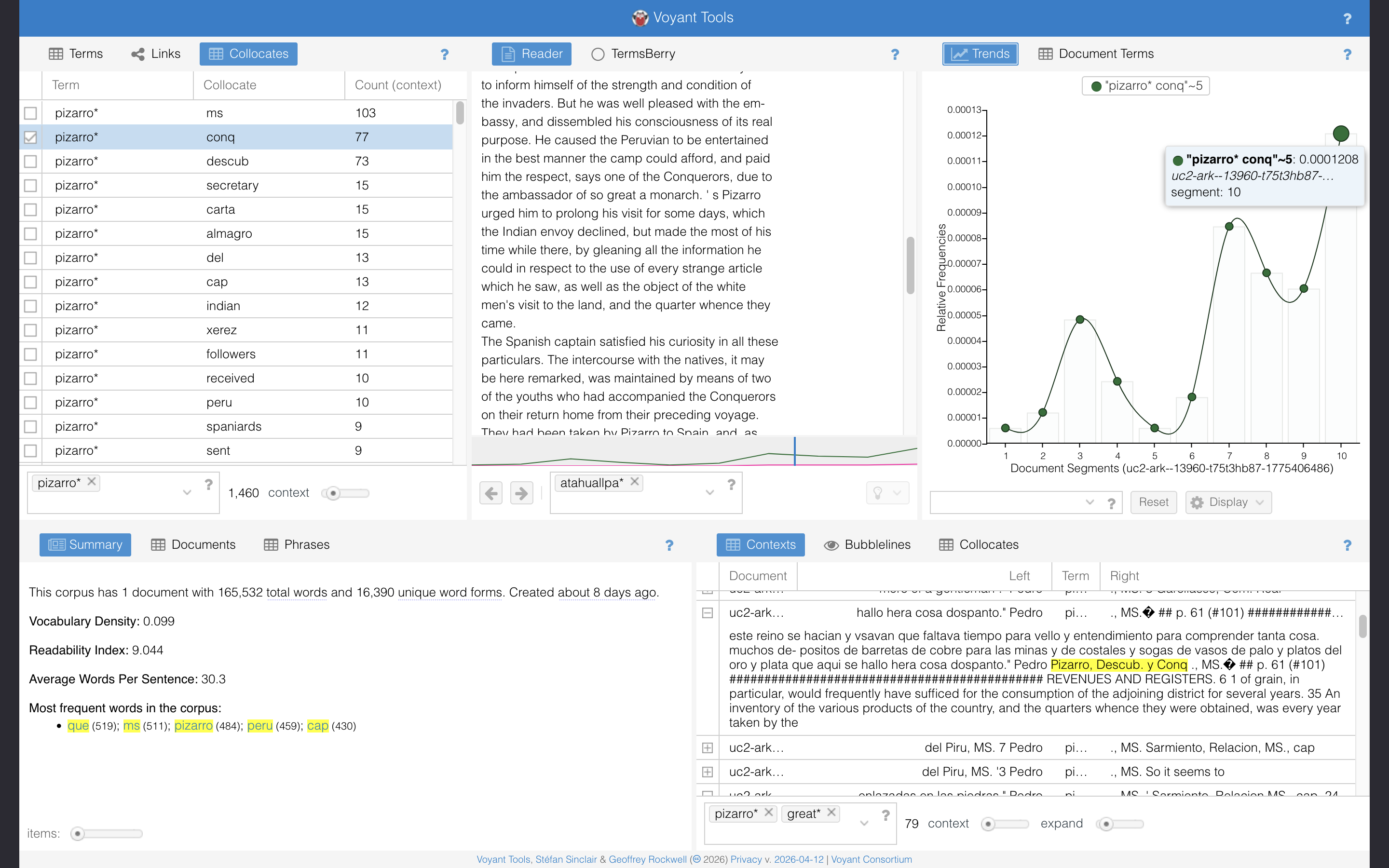
The document I chose for this exercise was the “History of the Conquest of Peru” by William H. Prescott. It was written in 1847, although the version I’m analyzing here was published in 1874. As the title suggests, the book is about the Spanish conquest of Peru, or, more specifically, the Inka Empire (also known as Tawantinsuyu). I chose this text because I’m interested in the history of South America, and because it’s fairly long, so there is a lot to analyze here. Well, for one thing, this tool is incredibly useful. It is very difficult to manually search an entire book for certain terms. It would take a long time to do so, but with tools like Voyant Tools this task becomes quite easy and efficient. It makes analyzing a text much simpler, but it’s not perfect and it shouldn’t be relied on. What I mean by this is that analyzing the number of times a certain word appears in a text might not offer any important information about said text. For instance, the word “Pizarro” appears 484 times in the “History of the Conquest of Peru,” but that’s because he was the leader of the expedition that toppled Tawantinsuyu, so it makes sense that his name would be mentioned that many times.
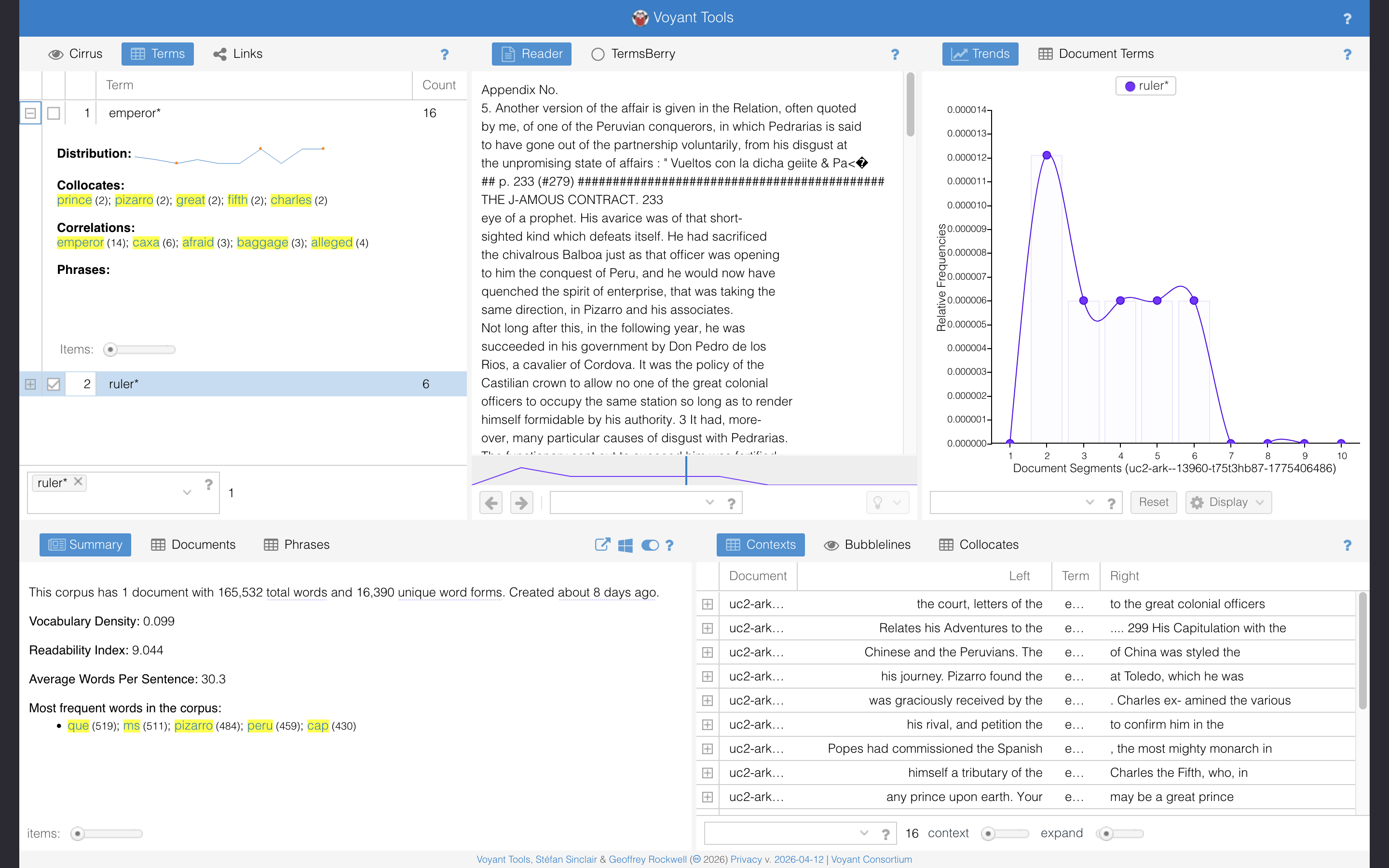
The emperor of Tawantinsuyu (or the Sapa Inka), Atawallpa, is mentioned 127 times, which, again, makes sense as he wasn’t part of the conquest, but I think it would have been better if he was mentioned a few more times (note: I’m spelling Inka-related terms in Quechua, or at least as close to Quechua as possible. For instance, Atahuallpa is usually spelled the way I just wrote it—Prescott spelled it like this too—but I’m spelling it like “Atawallpa” because that’s how it’s spelled in Quechua). However, this may not be all the times Atawallpa was mentioned directly or alluded to in this book; Prescott could have referred to him as the emperor or ruler of the Inka Empire instead of his real name. When I search up the term “emperor,” he was usually referring to European emperors, so what I wrote in the previous sentence is not the case here, but in other texts, leaders and other important figures could be referred to by some other title, so it's important to note when this happens so that you can accurately track when someone is mentioned in a text. Also, this tool might be difficult to use for physical books that haven’t been digitized yet, or if you have a book you want to analyze but can’t find any digital copies of. Thankfully, many books do have digital versions so this may not be a serious problem, but it’s something worth considering. I think that, for the most part, Voyant Tools is a useful tool that can help almost anyone analyze a text. You could analyze a wide variety of writings with this tool, so anyone from any discipline, or even a layman, can use it to look for interesting patterns in an article or paper. I, for one, will probably use Voyant Tools to review articles I read online, and I assume you could even use it to analyze texts and see the kinds of words people use in these kinds of settings.
I procrastinated on this exercise because I thought that Voyant Tools would be annoying to use, but as I was working with it, I ended up enjoying it more than I thought I would. It’s not that hard to use, but it looks intimidating at first. I’m not an expert in it by any means, but I would like to use it in the future.